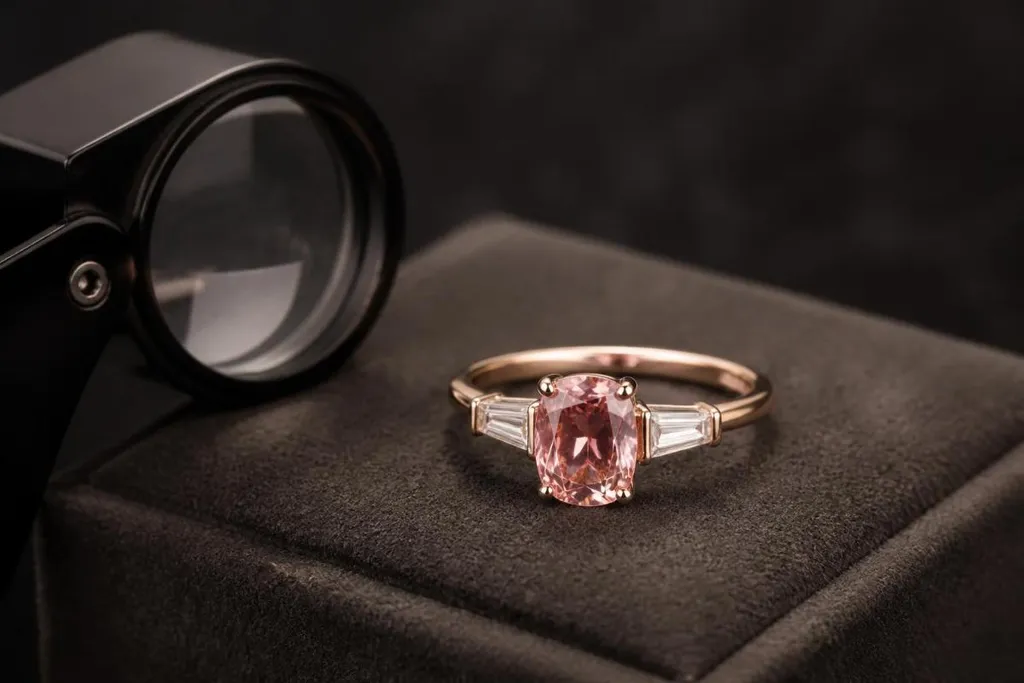
Some gemstones are defined by a single familiar colour. Padparadscha sapphire is prized for something more nuanced: an unusual meeting of pink and orange that can evoke the warmth of a sunset. Neither straightforwardly pink nor conventionally orange, its appeal lies in the balance between the two, giving an engagement ring a character that feels romantic without relying on familiar bridal colours.
For couples exploring timeless lab grown padparascha engagement rings, this distinctive palette offers an intriguing alternative to traditional colourless or blue centre stones. Lab-grown padparadscha sapphire brings the chemistry and crystal structure of sapphire together with carefully created pink-orange colour, while cut, setting and metal choice determine whether the finished ring feels softly understated or deliberately vibrant.
What Makes Padparadscha Colour So Distinctive?
The name padparadscha is traditionally associated with sapphires displaying a combination of pink and orange. The precise balance can vary, which is part of the reason these stones have such individual character.
Some lean towards delicate peach or salmon, while others show a stronger interplay of pink and warm orange. For an engagement ring, there is little value in choosing purely according to which colour appears strongest. The more important question is whether the combination feels harmonious to the wearer.
Lighting deserves particular attention. Warm interior light may emphasise peach and orange notes, while natural daylight can reveal the pink component differently. Viewing the gemstone across several environments gives a more realistic understanding of its everyday appearance.
This subtle variability is part of the appeal. Padparadscha colour has enough warmth to be distinctive, yet its blended character can make it surprisingly versatile alongside other jewellery.
Cut and Proportion Influence the Sunset Effect
Cut determines how colour is distributed across a gemstone and how effectively light brings that colour to life.
Oval padparadscha sapphires can be particularly elegant, with their elongated proportions providing generous visual coverage along the finger. Cushion cuts reinforce the stone's softer character through rounded corners and a substantial outline.
Round stones provide symmetry and a more familiar engagement-ring silhouette, allowing the unusual colour to supply the individuality. More geometric shapes can offer an interesting contrast, placing the warm pink-orange palette within cleaner, sharper lines.
Carat weight should be considered alongside actual dimensions and colour. Someone might prefer a 2-carat centre stone because its larger face allows the nuanced sunset tones to become more visible. Another wearer may choose a smaller sapphire surrounded by diamonds, using contrast and setting design to establish presence instead.
Scale should serve the colour rather than overwhelm it.
Metal Choice Can Shift the Overall Palette
Padparadscha sapphire responds dramatically to the metal surrounding it.
Rose gold can create a beautifully tonal composition, echoing the gemstone's pink and peach notes. The result tends to feel soft and romantic, with less obvious separation between centre stone and band.
Yellow gold emphasises warmth from a different direction. It can draw attention towards the sapphire's orange or golden undertones, giving the ring a rich fine-jewellery character.
Platinum and white gold offer greater contrast. Their cool appearance provides a neutral frame against which the pink-orange centre stone can stand out clearly. Colourless diamond accents reinforce that contrast further.
A solitaire keeps the colour visually uninterrupted, while a diamond halo creates a bright border around the sapphire. Diamond-set shoulders add brilliance more discreetly, leaving the centre stone's outline clearly defined.
Sapphire Durability Supports Everyday Wear
Padparadscha sapphire is a variety of corundum and ranks 9 on the Mohs scale, giving it excellent resistance to scratching and making it well suited to engagement jewellery.
As with any gemstone, hardness does not mean immunity from damage. A strong impact can still affect the stone or setting, so removing the ring during heavy manual activities remains sensible.
Regular gentle cleaning helps prevent creams and soap residue from reducing the stone's brightness. Periodic professional inspections are equally worthwhile, particularly for checking claws and small accent stones.
Setting a profile should also suit the wearer's lifestyle and intended wedding band. A beautiful engagement ring still needs to function comfortably as part of an everyday bridal set.
Final Thought
Padparadscha sapphire engagement rings are distinctive because their colour resists a simple label. Pink, peach and orange meet in varying proportions, creating warmth that changes subtly with lighting and surroundings.
A thoughtfully chosen lab-grown padparadscha sapphire allows that nuanced colour to remain the focus. Pair it with a flattering cut, balanced proportions and a metal that either complements or contrasts its sunset palette, and the result can feel unusual without being trend-driven—an engagement ring with genuine long-term character.